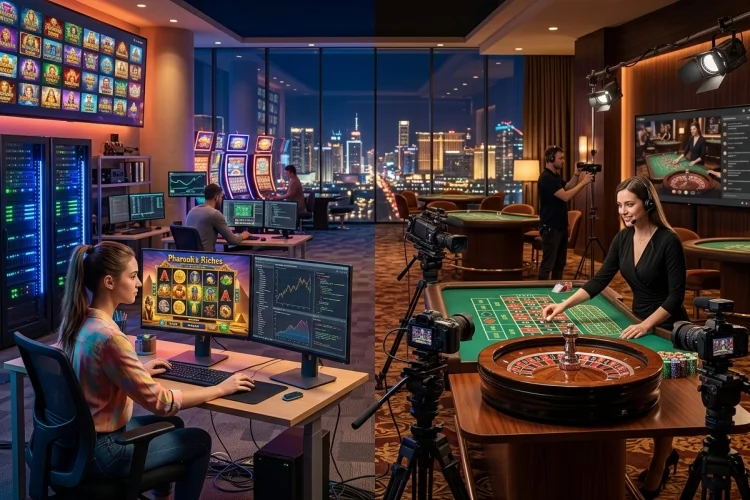
Online casino lobbies often place slots and live dealer games next to each other, but the companies behind these products operate in very different ways.
A slot developer may create hundreds of digital titles using mathematical models, animated reels, bonus rounds, and random number generator technology.
A live casino supplier must combine software with physical studios, professional dealers, gaming tables, cameras, and real-time streaming systems.
Understanding slot providers vs live casino providers helps players recognize why the two categories feel so different. Slots usually offer quick rounds, flexible betting ranges, and a wide variety of themes.
Live games focus more heavily on human interaction, authentic table procedures, and an experience that resembles a physical casino.
Neither provider type is automatically better. Their value depends on what a player expects from an online gaming session.
By examining their technology, game variety, pace, testing standards, and social features, it becomes easier to choose the format that matches individual preferences.
The Core Difference Between the Two Provider Types
Slot providers primarily develop software-based games in which results are generated digitally. Their teams include game designers, mathematicians, programmers, sound engineers, animators, and compliance specialists.
Live casino providers operate a more complex service. In addition to developing the betting interface, they manage studios, train game presenters, inspect physical equipment, supervise tables, and broadcast every round to connected players.
A live game is therefore not simply a video of a casino table. The video stream, betting system, dealer actions, result recognition, and player balances must remain synchronized throughout the session.
Regulatory standards require live dealer operations to be fair and independently auditable.
How Slot Providers Create Game Results
Most online slots rely on a random number generator, commonly called an RNG. This system continuously produces numerical values that the software converts into reel positions and game outcomes.
A player pressing the spin button does not physically move the reels. Instead, the software selects an outcome and then displays the matching animation.
Regulators require digitally generated results to be acceptably random and unpredictable, while testing laboratories examine whether an RNG contains bias or predictable patterns.
Slot providers also design the mathematical framework behind each title. This includes return to player, hit frequency, volatility, symbol probabilities, bonus frequency, and maximum win potential.
These characteristics can make one game deliver small prizes regularly while another produces fewer but potentially larger payouts.
How Live Casino Providers Run Games
Live casino providers use physical cards, roulette wheels, dice, or other commercial casino equipment. A trained dealer conducts the game while cameras transmit the action to players using computers or mobile devices.
The result may be captured through optical character recognition, sensors, manual confirmation, or a combination of systems. The digital interface then settles wagers according to what happened at the table.
Independent live dealer evaluations may examine studio premises, staffing, technical systems, synchronization, operational responsibility, and equipment controls.
These requirements explain why launching a live casino product is usually more operationally demanding than releasing a conventional slot.
Differences in Pace and Player Interaction
Slots are designed for individual, on-demand play. A round can normally begin whenever the player chooses, and there is no need to wait for other participants.
Live tables follow a scheduled betting cycle. Players receive several seconds to place wagers before the dealer closes betting and begins the round. This format creates a slower, more structured rhythm.
The main advantage of live gaming is interaction. Players may communicate with the presenter or see wagers from other participants. Slots offer less direct social contact, although tournaments, shared jackpots, and community features can make them feel more connected.
Players who prefer uninterrupted and fast gameplay may favor slot developers. Those who value atmosphere, recognizable table procedures, and human presentation may be more attracted to live casino studios.
Game Variety and Creative Freedom
Slot providers have significant creative flexibility. They can develop games around fantasy, history, adventure, mythology, television-style entertainment, or almost any other theme.
Their mechanics can include expanding wilds, cascading symbols, free spins, multipliers, progressive jackpots, and adjustable paylines. Because everything is digitally generated, developers can experiment without being limited by a physical table.
Live providers traditionally focus on blackjack, roulette, baccarat, poker variants, and dice games. However, the category has expanded through live game shows, bonus wheels, augmented graphics, and hybrid formats.
Some companies now supply both categories. Evolution, for example, describes a portfolio covering live casino, game shows, RNG table games, and slots, showing that the boundary between the two sectors is becoming less rigid.
Fairness, Testing, and Transparency
Both provider types must meet technical and regulatory standards in licensed markets. Slot testing commonly covers the RNG, game mathematics, paytable accuracy, prize calculations, and interrupted rounds.
Live casino testing places additional emphasis on dealer procedures, surveillance, equipment quality, studio access, result recording, and video synchronization.
An independent laboratory may conduct both remote assessments and physical inspections of the studio.
Players should remember that fairness does not mean every session will produce a win. It means the game operates according to approved rules and does not systematically manipulate outcomes against particular users.
Reputable providers make rules, payout information, and game instructions easy to access. Their products should also explain how unfinished rounds or connection failures are handled.
Gambling Commission standards state that interruption policies should be fair and should not systematically disadvantage customers.
Which Type of Provider Offers the Better Experience?
The answer depends on the player rather than the provider category. Slots are often suitable for people who want quick access, extensive themes, short rounds, and greater control over the pace of play.
Live casino games are more appropriate for users who enjoy traditional table games and prefer watching a real presenter conduct each round. They can create a stronger sense of occasion, although they may require a more stable internet connection and longer session time.
Players do not need to choose only one category. A regulated casino with reputable suppliers can offer slots for convenient individual play and live tables for a more interactive experience.
The comparison of slot providers vs live casino providers reveals two very different approaches to online gaming. Slot developers build RNG-based products around mathematics, visual creativity, and rapid digital gameplay.
Live suppliers combine software with dealers, studios, physical equipment, surveillance, and real-time broadcasting. Both can deliver fair and engaging products when they are properly licensed, tested, and transparently operated.
Players should examine the provider’s reputation, game rules, certification, and available responsible gambling controls before participating.
Explore both formats through legal and regulated platforms, compare their pace and features, and choose games that fit your entertainment preferences.
Set a clear budget, monitor the time spent playing, and never treat gambling as a dependable source of income.